
A new Tiffany & Co. flagship store has opened in the Taikoo-Li Sanlitun commercial neighbourhood in Beijing, with a façade of curving, translucent glass fins that add an ethereal presence to the building. With its flowing shapes inspired by the masterpieces of jewellery designer Elsa Peretti, the Beijing store is the fifth in a series of façade designs created by MVRDV for Tiffany, introducing a new design motif that reflects the pursuit of innovative materials and expressive three-dimensional form that characterises each design in the series.
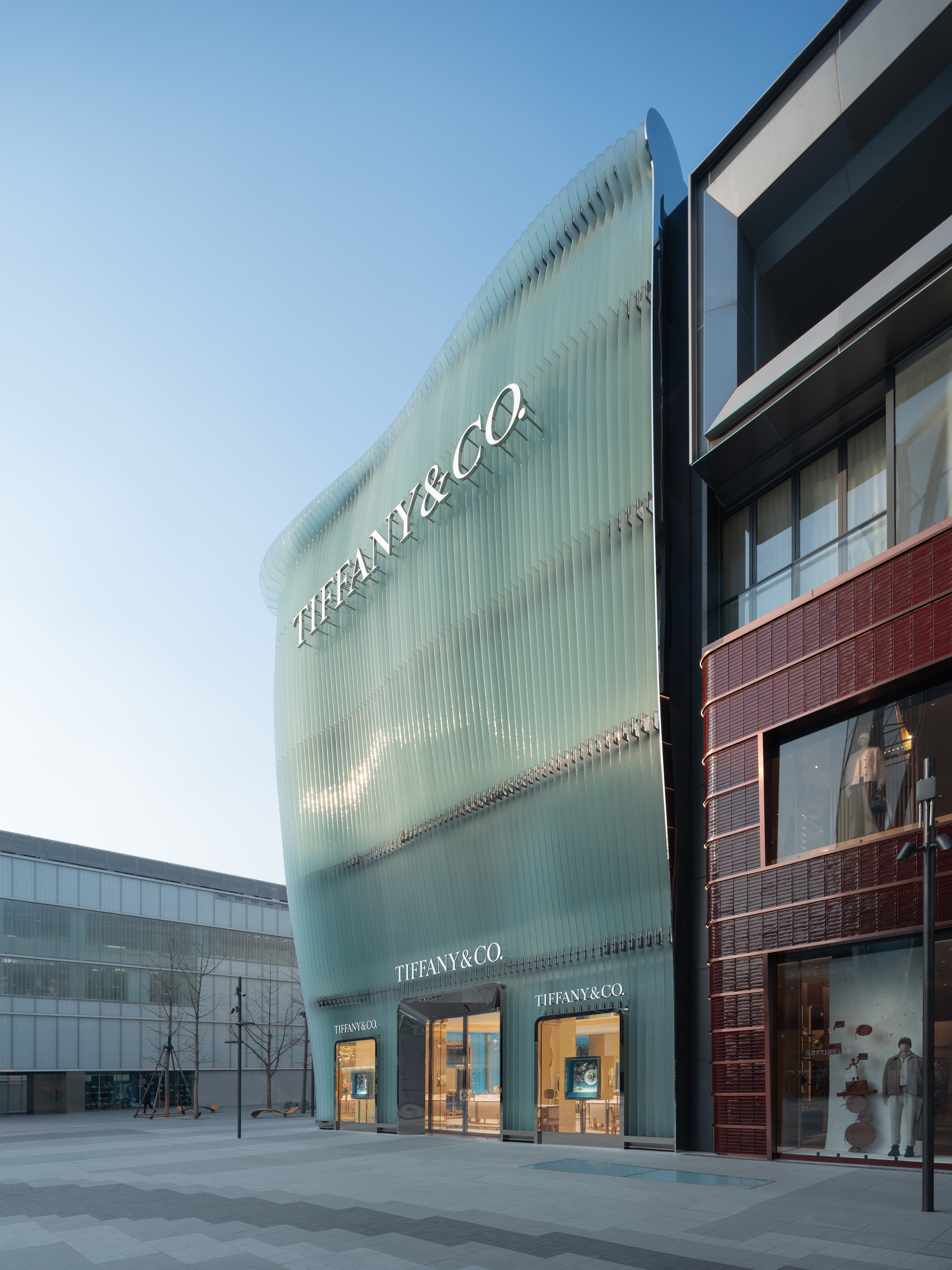
The store is located at a crossroads in the northern section of the Taikoo-Li Sanlitun, where luxury brands predominate. To take advantage of its location, the façade is adorned with translucent, textured glass fins that rise vertically up the full four-storey height of the building. With their gently curved edges, these responsibly recycled and locally manufactured fins give the façade an elegant, fluid form. In order to design this shape, MVRDV took cues from the Bone Cuff by Elsa Peretti®.
.jpg)
“When viewed from an angle, the layering effect of the dense glass fins amplifies the effects of the light, highlighting the façade’s shape”, says MVRDV founding partner Jacob van Rijs. “The light filtering through and reflecting off of the translucent glass creates a delicate interplay that is constantly changing as you move. And, as you pass close to the building, you see glimpses in between the fins to the jewellery inside.”
.jpg)
At night, the glass – already carefully selected for its natural blue tone – is illuminated in Tiffany & Co.’s iconic Tiffany Blue®, giving the store a diffuse glow. To ensure an elegant appearance, lighting modules are built directly into the specially designed brackets that hold the glass fins, minimising the presence of hardware that might distract from the subtle light effects created by the glass.
.jpg)
The façade is designed to be demountable, allowing the glass fins and mounting brackets to be removed without damage and enabling the possibility for these components to be reused or recycled at the end of their lifespan.
See more of the Tiffany Beijing Façade here.